


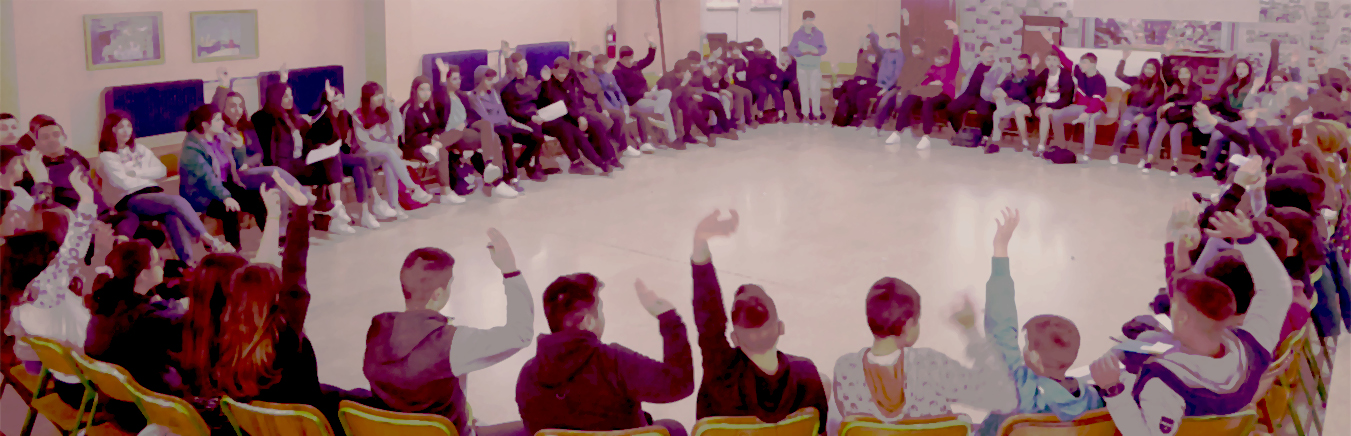
On the occasion of World Children's Day (20 November), PROTA.12 / INART.12 (Initiative for Article 12 of the UN Convention on the Rights of the Child) proposes organising the dialogue activity “Let’s Talk About Democracy in Our Classroom and School”. It was designed by Giorgos Moschos, former Greek Ombudsman for Children, together with members of PROTA.12, drawing on a checklist about democratic schools available on the Council of Europe's website:
https://www.coe.int/en/web/campaign-free-to-speak-safe-to-learn/dsn-checklist
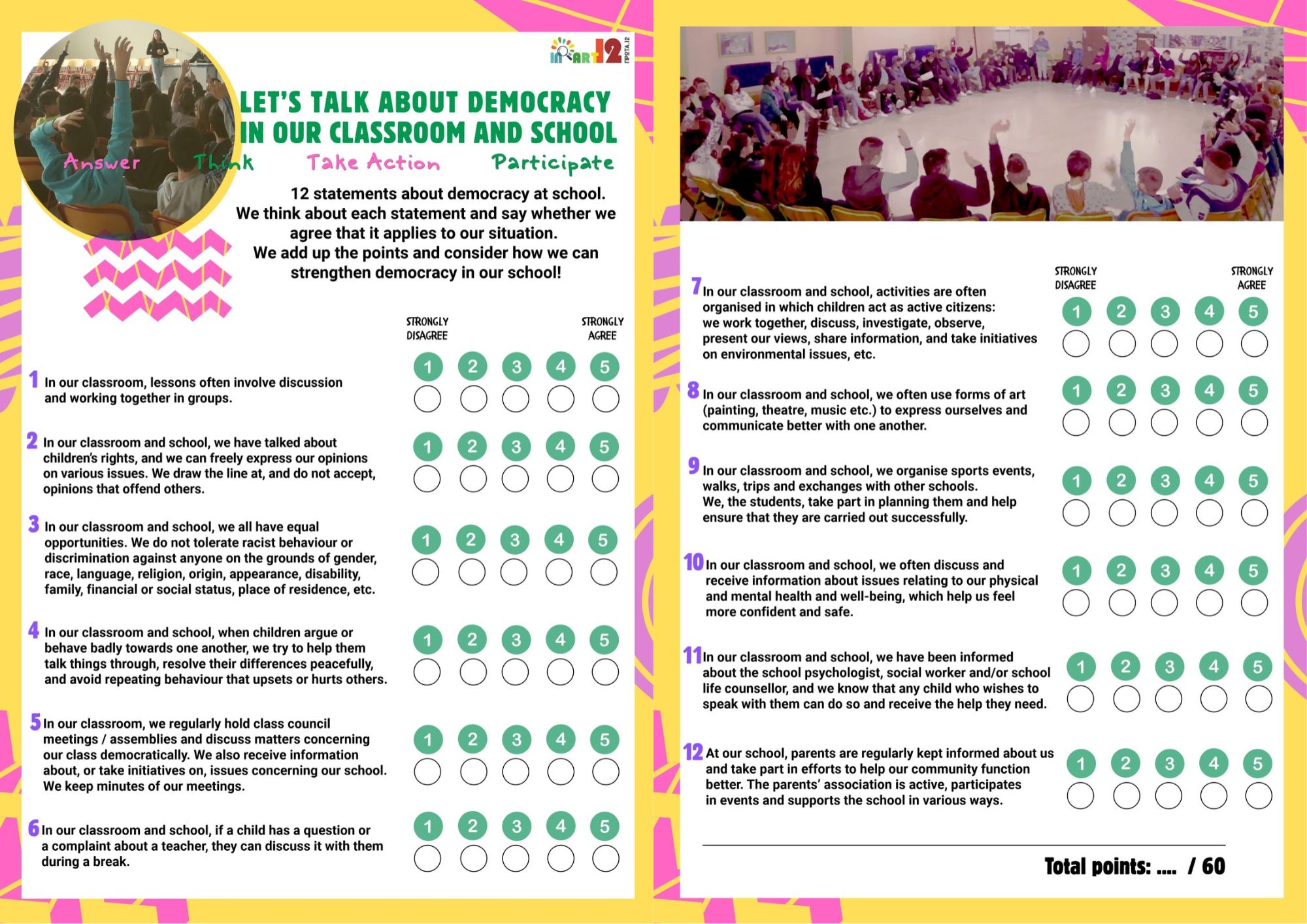
Children are invited to express their views on 12 statements concerning the democratic functioning of their classroom and school by ticking a scale from 1 to 5 to indicate the extent to which they agree that each statement applies.
The statements are included in a two-page handout that teachers can download here.
 The activity can take place alongside a discussion about the meaning and protection of children’s rights, and in particular Article 12, which concerns children’s right to express their views freely. It is suitable for lower and upper secondary school classes, or for the 5th and 6th grades of primary school.
It is suggested that children be reminded that 20 November was established as “World Children’s Day” because, on this day in 1989, the United Nations General Assembly adopted the Convention on the Rights of the Child, an international legal instrument for children that subsequently became law in the countries that ratified it (Greece did so in 1992). All children’s rights are important and must be respected by adults and children alike.
In this activity, we focus in particular on the rights protected by the following Articles of the Convention:
Article 2, which prohibits discrimination against any child.
Article 12, which establishes children’s right to express their views freely.
Articles 13 and 17, which address freedom of expression, access to information and the search for information.
Article 14, which concerns freedom of thought, conscience and religion.
Article 15, which concerns children’s right to assemble peacefully.
Article 16, which protects children’s privacy.
Article 18, which concerns the responsibilities of children’s parents.
Article 19, which prohibits all forms of violence, insult, neglect or mal-treatment of children.
Articles 22, 23 and 30, which concern the rights of refugee children, children with disabilities / special needs, and children belonging to minorities.
Article 24, which recognises children’s right to healthcare for their physical and mental health.
Articles 28 and 29, which concern the right to education in connection with the development of children’s personalities and respect for children’s rights.
Article 31, which concerns children’s right to rest, play, recreation, leisure activities, and participation in cultural and artistic life.
The teacher explains to the children that the aim of the activity is to help the class reflect on and consider actions relating to the democratic school, which is directly connected to students’ rights. A democratic school is not only about student council elections or the way decisions about school life are made. It is also, more broadly, about how the school operates, the atmosphere within the school and its classrooms, and whether students feel that they are heard, that they are safe, and that their relationships with other members of the school community are peaceful and cooperative.
Using the handout with the 12 statements, children respond anonymously to each statement by indicating their level of agreement on a scale from 1 to 5, where 1 means “strongly disagree” and 5 means “strongly agree”. The aim is not to conduct research, but to open up a classroom discussion based on their answers. During the discussion that follows, children who believe that things at their school could be improved can suggest specific ideas and actions.
The class then discusses each statement in turn, including the reasons why the children indicated that they agree or disagree, and whether they believe that they themselves also have some responsibility for shaping the democratic character of their classroom and school.
To conclude the discussion, the teacher asks the children what they think needs to be done as a priority in their classroom and school to make them more democratic, and above all to help children feel safer and more satisfied while attending school and participating in community life.
As part of the activity, students may raise complaints about adults’ responsibilities for the democratic character of the school. Teachers who distribute the handout and discuss it with the children should be prepared to listen to them and help them critically examine both issues relating to the education system and the responsibilities of teachers, students and their parents. It is recommended that one full lesson period be devoted to the activity described.
At the end of the lesson, the teacher collects the completed response sheets. If they wish, they can add up the scores and, at a later time, inform the class of the average score, reminding the children of their ideas and suggestions for further action.